4 Amazing Secrets of the Sunflower
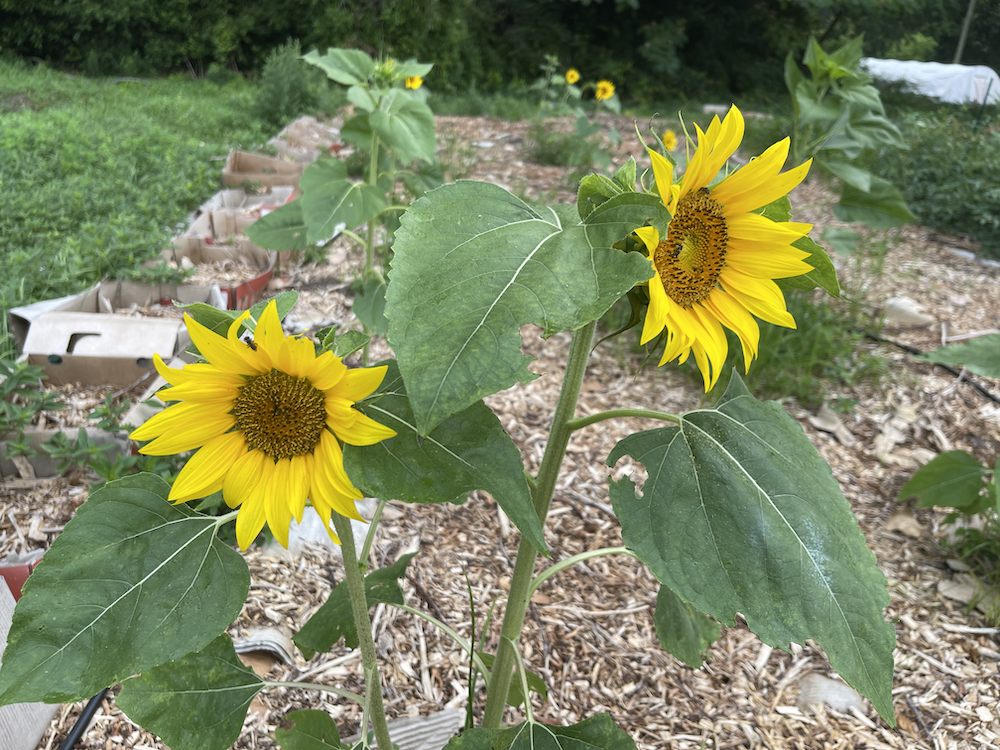
If you’ve walked by our garden lately, you’ve probably noticed our sunflowers are hitting a serious growth spurt, especially the ones at the far edge! These sunflowers have officially crossed the 3-foot mark, and they are thriving.
Most of us know sunflowers for their signature move: tracking the sun from east to west every day. But as our plants gear up for their big blooming finale, we dug a little deeper. It turns out, sunflowers have a few hidden superpowers that most people never talk about.
Here are four incredible things our students are learning about these giants:
1. The "Flower" is Actually a City of Thousands
When you look at a sunflower, you aren’t looking at just one flower. You are looking at a literal community!
The giant head is actually a pseudanthium (false flower) made up of one to two thousand tiny individual flowers working together.
The Ray Florets: These are the bright yellow "petals" on the outside. They are actually sterile flowers whose only job is to act like a giant neon billboard to attract bees.
The Disc Florets: The dark center is made of thousands of tiny, fertile flowers. Each one of these will eventually get pollinated and turn into a single sunflower seed.
2. They Are Master Mathematicians
Sunflowers don't just grow randomly; they follow strict mathematical laws. If you look closely at the center of a sunflower head, you will see the seeds are arranged in perfect, intersecting spirals.
Count the spirals going clockwise and counterclockwise, and you will find they are almost always consecutive numbers in the Fibonacci sequence (1, 2, 3, 5, 8, 13, 21, 34, 55, 89...). This precise geometry allows the plant to pack the maximum possible number of seeds into the absolute minimum amount of space without crowding. Nature's perfect packaging!
3. They Are Toxic to Other Plants (On Purpose!)
Sunflowers look friendly, but they are fierce competitors in the garden. They practice something called allelopathy.
Sunflower roots, leaves, and stems exude chemical compounds into the surrounding soil that inhibit the growth of other plants. It’s a built-in defense mechanism that prevents competing weeds from stealing their water, nutrients, and sunlight. It’s their way of claiming their personal space!
4. They Help Clean Up the Planet
Sunflowers aren't just pretty faces; they are hard-working environmental cleaners. They are known as hyperaccumulators, meaning they have an incredible ability to absorb toxic heavy metals and radiation from the soil through their roots.
During the process of phytoremediation, the plants pull toxins up into their stems and leaves, locking them away and cleaning the earth below them. In fact, sunflowers were famously planted by the thousands to help clean up the soil after the nuclear disasters at both Chernobyl and Fukushima.
What’s Next for Our Classroom Giants?
Right now, our sunflowers are focusing all their energy on building strong stems to support the massive heavy heads that will soon appear. Once the flowers fully open, they will actually stop tracking the sun entirely and permanently face East to stay warm and welcome the morning pollinators.
Stay tuned for more updates as our green engineers keep reaching for the sky!